Most of us probably don’t give much thought to the products under our kitchen sink. We spray the counters, clean the bathroom, mop the floors, and disinfect when someone is sick. If a product is sold for household use, it’s easy to assume there isn’t much reason to think about what’s actually in it.
But cleaning products vary considerably in their ingredients—and some can irritate the skin, eyes, or respiratory system, especially with frequent use.
That doesn’t mean we need to be afraid of household chemicals or eliminate every conventional cleaner from our homes. It does mean that when an effective product can do the same job with ingredients that have fewer health or environmental concerns, it’s reasonable to consider that option.
As a nurse practitioner, that’s the approach I prefer: understand the potential risks, look at the evidence, and make practical choices that reduce unnecessary exposure without sacrificing effectiveness.

Why What We Clean With Matters
Cleaning products can contain a wide range of ingredients, including fragrances, solvents, bleach, ammonia, acids, and disinfecting agents. Depending on the product and how it’s used, some can release volatile organic compounds (VOCs) into the air or irritate the eyes, skin, and respiratory system.
The concern isn’t simply theoretical. Research has associated frequent exposure to some cleaning products—particularly sprays, disinfectants, bleach, and certain occupational cleaning exposures—with respiratory symptoms and asthma. More recent studies have also shown that the products we choose can make a difference in the chemicals released into our indoor air.
For example, studies comparing conventional and “green” cleaning products have found that some alternative products produce fewer potentially concerning VOCs. One study in which women switched to alternative cleaning products found significant reductions in exposure to several chemicals of concern—and almost all participants thought the new products cleaned just as well.
That’s encouraging because reducing exposure doesn’t necessarily mean sacrificing performance.
Cleaning vs. Disinfecting
Another simple way to reduce unnecessary exposure is to use the right product for the job.
Cleaning removes dirt, grime, and many germs from surfaces. For much of our routine household cleaning, that’s exactly what we need.
Disinfecting uses antimicrobial ingredients to kill specific microorganisms. It’s particularly useful when someone is sick or when a surface has a greater risk of contamination.
Not every surface needs to be disinfected every time it’s cleaned. But when I do use a disinfectant, I want one that’s proven to work while also being made with ingredients I’m comfortable using in my home.
What’s in Your Cleaner?
You don’t need to become a chemist to make informed choices. A few common ingredients are worth recognizing.
Chlorine bleach is a powerful and effective disinfectant, but it can also irritate the skin, eyes, and respiratory tract and can damage certain materials.
Ammonia is an effective grease-cutting ingredient found in some household and glass cleaners. Its fumes can irritate the eyes and respiratory system.
Quaternary ammonium compounds, or quats, are common in disinfecting products. They effectively kill many microorganisms, but frequent exposure to some quats has raised respiratory and other health concerns, particularly in occupational settings.
Fragrances and VOCs can also contribute to indoor air pollution or trigger symptoms in people who are sensitive to them. Sprays are especially worth considering because they can put cleaning chemicals directly into the air we breathe.
Because safe and effective alternatives are available, I personally choose cleaning and disinfecting products that don’t contain chlorine bleach, ammonia, quats, or synthetic fragrances and VOCs.
Effective Alternatives
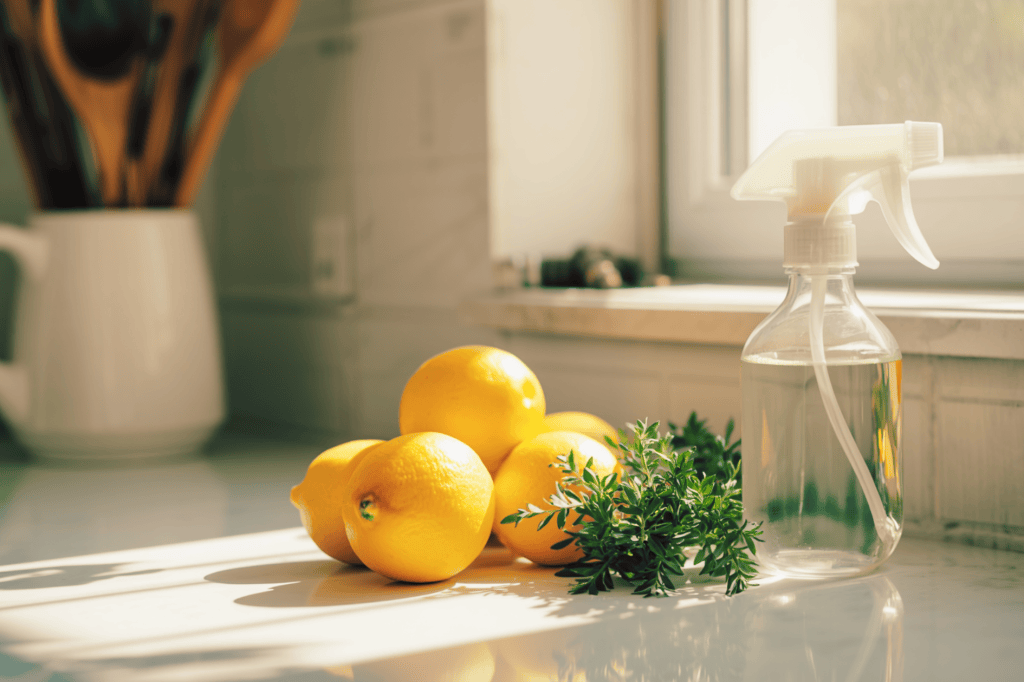
The good news is that effective cleaning doesn’t have to depend on harsh compounds.
Products formulated with ingredients such as thymol, citric acid, lactic acid, and hydrogen peroxide can provide effective cleaning and disinfecting with fewer health and environmental concerns than many traditional cleaning ingredients.
Thymol, for example, is derived from thyme and has antimicrobial properties. It’s used as an active ingredient in some EPA-registered disinfectants. Recent research comparing a thymol-based cleaner with bleach- and quat-based products also found fewer unique VOCs released from the thymol product during simulated household cleaning.
Citric acid and lactic acid are organic acids that can be used in cleaning products and as active ingredients in certain disinfectants. Hydrogen peroxide is another effective antimicrobial ingredient used as an alternative to chlorine bleach in some products.
These aren’t simply ingredients that sound gentler. They can be used to formulate products that actually clean and disinfect effectively.
How Do You Know a Disinfectant Works?
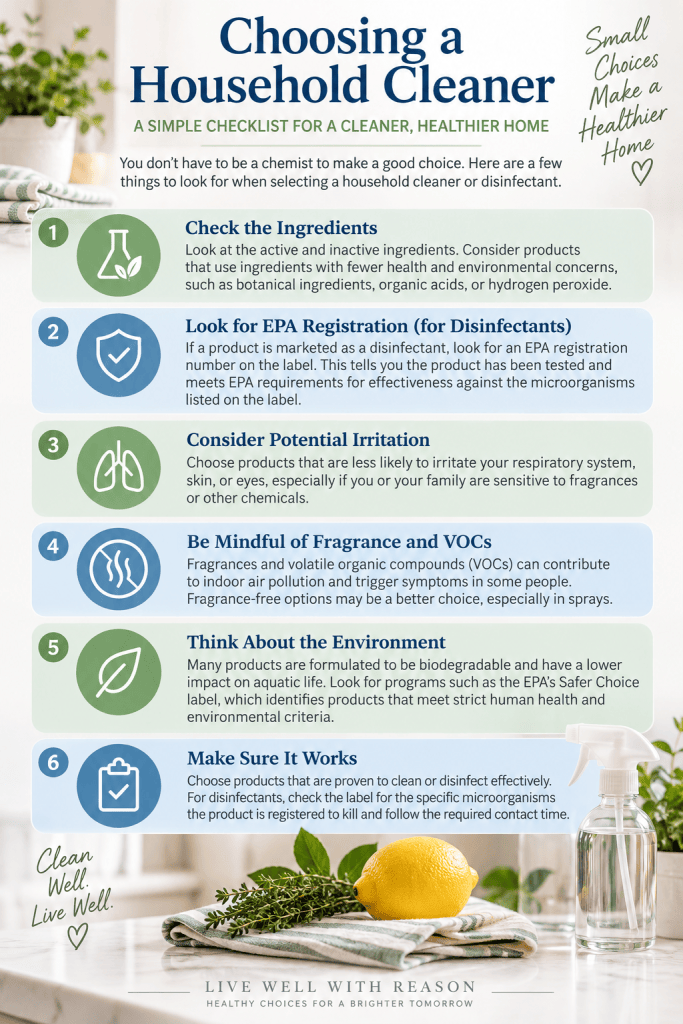
Here’s one of the easiest things to check: look for an EPA registration number on the label.
If a product is marketed as a disinfectant, EPA registration tells you that it has met requirements for effectiveness against the microorganisms listed on its label.
That means you don’t necessarily have to choose between a product with ingredients you prefer and one that works. There are EPA-registered disinfectants made with both conventional and botanical active ingredients.
The EPA’s Safer Choice program can also help identify cleaning products whose ingredients meet health and environmental safety criteria while still meeting performance standards.
What I Look for in My Own Home
I’ve become more intentional about the products I use regularly. I personally choose cleaning products that don’t contain chlorine bleach or ammonia, and I’m especially interested in botanical and other thoughtfully formulated alternatives.
If it’s a disinfectant, I also look for EPA registration.
I especially appreciate products that combine effective cleaning and disinfecting with ingredients that reduce some of the health and environmental concerns associated with more traditional formulations.
One Important Safety Reminder
Whatever type of cleaner you choose, never mix cleaning products unless the label specifically tells you to do so.
In particular, never mix chlorine bleach with ammonia or acidic cleaners such as vinegar. These combinations can produce toxic gases and cause serious respiratory injury.
And when using a disinfectant, follow the directions for contact time. Many products need to remain wet on the surface for a certain amount of time to kill the microorganisms listed on the label.
The Bottom Line
The products we use to clean our homes are part of our everyday environment, and some commonly used cleaning ingredients come with potential health and environmental concerns.
The good news is that we have choices.
For me, healthy living is simple: if I can choose a safer product that works just as well and doesn’t cost significantly more, why wouldn’t I make the switch?
For me, this isn’t about being afraid of chemicals. It’s about reducing unnecessary exposures when better options are readily available.
That’s the kind of healthier choice that just makes sense.
This article is for general educational purposes and is not a substitute for individualized medical advice.
References & Further Reading
Pacheco Da Silva, A., et al. (2025). Effects of household cleaning products on the lungs: An update.
Quinn, M. M., Lindberg, J. E., Gore, R. J., Sama, S. R., Galligan, C. J., Kriebel, D., Markkanen, P. K., LeBouf, R. F., & Virji, M. A. (2025). Respiratory quaternary ammonium and volatile organic compound exposures experienced by home care aides during residential bathroom cleaning using conventional and green products. Annals of Work Exposures and Health, 69(2), 173–190. https://doi.org/10.1093/annweh/wxae092
Svanes, Ø., et al. (2018). Cleaning at home and at work in relation to lung function decline and airway obstruction. American Journal of Respiratory and Critical Care Medicine, 197(9), 1157–1163.
Temkin, A. M., Geller, S. L., Swanson, S. A., Leiba, N. S., Naidenko, O. V., & Andrews, D. Q. (2023). Volatile organic compounds emitted by conventional and “green” cleaning products in the U.S. market. Chemosphere, 341, 139570. https://doi.org/10.1016/j.chemosphere.2023.1395
U.S. Environmental Protection Agency. Safer Choice Program.
U.S. Environmental Protection Agency. Design for the Environment (DfE)-Certified Disinfectants.
American Lung Association. Cleaning Supplies and Household Chemicals.

 Live Well with Reason
Leave a comment